Multilingual Voiceover Guide: From Chinese Video to English Version
Multilingual voiceover is retelling, not translation. Three approaches, a six-step workflow, decision tables, and four common traps.
Read →Soundwaver · BLOG
Practical notes on AI text to speech: choosing tools, sounding natural, and turning voice into an advantage.
No good voice, no equipment? A seven-step workflow to plan, script, voice, edit, and publish a podcast with AI.
Read →Multilingual voiceover is retelling, not translation. Three approaches, a six-step workflow, decision tables, and four common traps.
Read →
ElevenLabs v4, Microsoft MAI audio models, and a doubled valuation: what happened in voice AI this week, and what creators should do.
Read →
A practical voice branding guide: why brands need a signature voice, four dimensions, a five-step setup, and how AI voiceover makes it affordable.
Read →
Taiwanese Mandarin is a speaking habit, not a character set. Four checkable tells, three test lines, and five common fake-accent traps.
Read →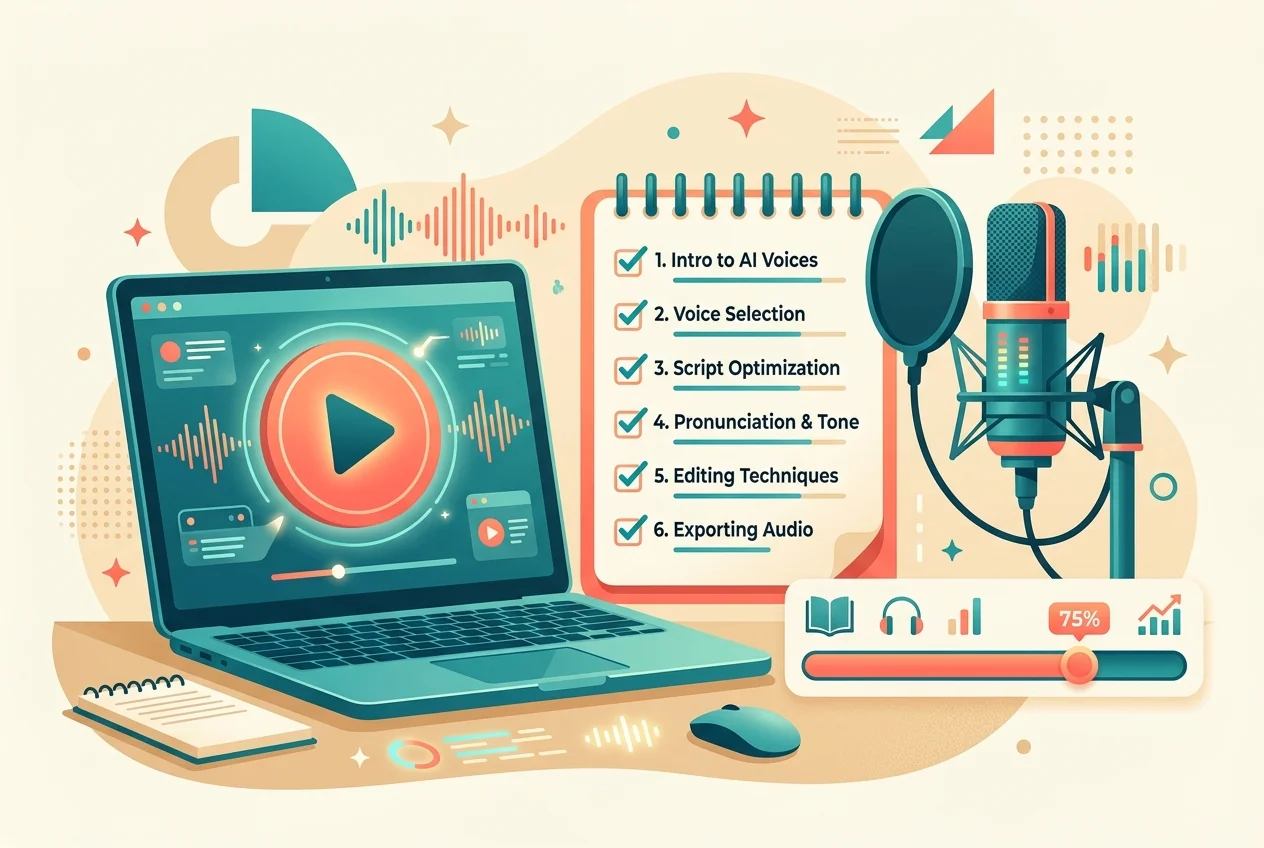
A real case where an all-AI course halved completion. Seven-step mixed workflow, AI ratios by course type, and what keeps students listening.
Read →
The hard part of AI audiobooks is lowering redo cost. Covers listenable text prep, voice strategy, chapter archiving, long-paragraph handling, and delivery checks.
Read →
Three formulas to calculate AI voiceover cost: monthly minutes, cost per minute, and payback. Includes hidden fees and a budget template.
Read →
Turn AI voiceover into a repeatable process: three script templates, five writing rules, segment-based generation, and an 8-item pre-publish checklist.
Read →
Plain-language intro to AI speech generation: how it works, three modes, pricing math, license checks, and a 30-minute plan.
Read →
Write, pick a voice, test, fix, license, and publish. Includes test scripts, fix table, and a 30-minute plan.
Read →
Recording prep, cloning steps, pricing math, and consent rules in one guide. Includes test scripts, decision table, and FAQ.
Read →
Same real script, six free Chinese TTS tools scored on naturalness, Taiwanese Mandarin, free quota, and commercial rights. Decision table + FAQ.
Read →
Tag who speaks, give each role a voice, keep narrator and dialogue separate — with casting tips and FAQs.
Read →
Done generating? Mastering, rights, cover, and platforms — how to turn AI chapters into a product.
Read →
Shorts are won or lost in three seconds. Hook formulas, a 15-second structure, and AI pacing tips.
Read →
Cloning takes 30 seconds. Consent is the part people skip. A plain-language guide to permissions, commercial use, and red lines.
Read →
Per second, per character, or per generation? How to compare AI voiceover prices without getting lost in billing units.
Read →
Most “Chinese TTS” sounds like a news anchor or a tourist. Here is how to listen for particles, rhythm, and word choice — and find a real Taiwanese Mandarin voice.
Read →
No studio, no waiting on talent. From script to export in three minutes — with copy-paste steps and common mistakes.
Read →
The AI read "bank" as a place to sleep and turned 3.5万 into a math lecture. Ten real TTS blooper categories, each with a five-second fix you can apply before you hit generate.
Read →
My client blamed the AI voice for 100-view videos. Four months of testing says YouTube punishes content nobody finishes. Checklist inside.
Read →
Three instructors, three course formats, one AI voice pipeline. Script adaptation, voice selection, and every pitfall I hit along the way.
Read →
No microphone, no studio, no audio engineer. I produced an entire season of podcast episodes using AI voice. Here is every step, start to finish.
Read →
Same script, fifty voices, two full days. These are the five filters that actually separate usable voices from demo-only ones.
Read →
Comedy lives in timing, not in your script. I made 50 meme videos with AI narration — here are the voice choices, pacing tricks, and copy-paste script structures that actually landed.
Read →
AI voices always sound fake. Platforms bury TTS content. Ten seconds clones anyone. I tested the ten biggest claims — here is what held up.
Read →
Same engine, different scripts: one sounds like a person, the other sounds like a vending machine. Eight tested rules for writing voiceover scripts, with before/after rewrites.
Read →
The office turned around: my BGM was only 4 dB under the voice. Real numbers inside: bed -15 dB, ducking -6 to -10, tempo, license traps.
Read →
Distortion, wrong breaks, mispronounced words, uneven pacing, mismatched volume. When the same workflow suddenly goes wrong, stop guessing—use this checklist.
Read →
The same sentence, and it just doesn't sound Taiwanese. Five test sentences and a word table that show you how to tell, in seconds, whether a voice was made for Taiwanese ears.
Read →
Ads going live, videos being monetized, contracts due—then the licensing falls apart. Three real screw-ups that explain the difference between tool rights, voice rights, and finished-audio rights, plus a pre-flight checklist.
Read →
Short scripts hide every weakness. When I turned a 100,000-word manuscript into an audiobook with AI, the problems surfaced fast. Here's the full playbook.
Read →
Forty-eight videos, twelve hours of course material, one instructor who refused to go back into a studio. My first full commercial AI voiceover project, recorded honestly.
Read →
Code-switching is how Taiwanese people actually talk—but AI voices often butcher it. Here's what breaks, how to prep your script, and a template you can copy.
Read →
Does it sound fake? Does it cost money? Is my text safe? Can I use it commercially? I've answered these a hundred times, so I wrote them all down.
Read →
"Make it sound excited" doesn't work. Punctuation, pacing, and word choice do. Here's what a week of trial and error taught me about putting real feeling into AI voiceover.
Read →
Budget, turnaround, emotion, revision cycles—four dimensions that decide whether a project needs a human or an AI. Includes my real quotes, my split table, and how I explain the choice to clients.
Read →
Three hundred saved articles I never read became twenty minutes of listening every day on the train. The full workflow, what worked, what didn't, and which articles you should never convert.
Read →
Ninety seconds of sample audio, twenty minutes of waiting—now my voice can read anything I write. After thirty real voiceovers: what it's great at, what it fails at, and how to record a sample that works.
Read →
The same script can sound like a textbook or a person. The difference is punctuation, pacing, and phrasing—here is what actually changed my results.
Read →
Free tiers come with strings attached: quotas, license rules, voice libraries. Here is a use-case-by-use-case breakdown, tested with my own scripts.
Read →
You hear synthetic voices every day—navigation, assistants, video narrations. Here's how text-to-speech actually works, in plain language.
Read →