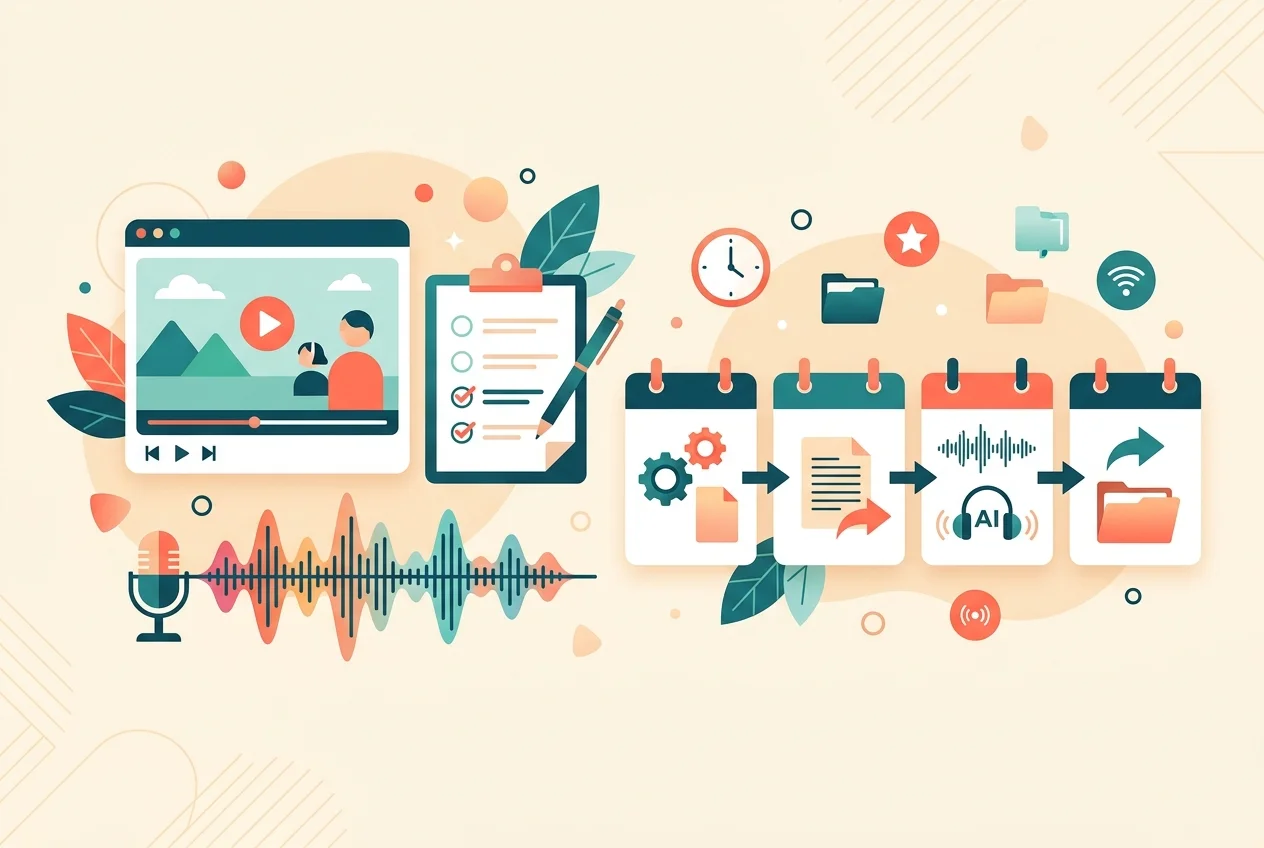
If you search “AI speech generation”, “voice synthesis”, or “text to speech AI”, you want plain answers: how it works, what you can make, and what it costs.
This intro guide (~2,000–3,000 Chinese characters in the Chinese edition) covers principles, workflows, pricing, and licenses without jargon.
Quick answer
| Your case | Start here |
|---|---|
| First time | Test 5 lines on TTS |
| Taiwanese Mandarin | Taiwanese Mandarin |
| Sound like you | Voice clone |
| Free budget | Small tests only |
| Ads / monetization | Confirm license first |
One line: AI speech generation is just turning text into sound. Quality is half your script.
Three common modes
- Normal TTS — built-in voices
- Voice cloning — your sample, your voice
- Emotion / director control — tags and staging
Most teams mix all three.
Four hard parts in Chinese
- Particles
- Neutral tones
- Numbers
- Local wording
Minimal workflow
- Write 5 real spoken lines
- Pick a tool and generate
- Check timbre, particles, numbers, long sentences
- Fix the script and try again
- Publish a 15–30s test first
Pricing in plain English
Ask: how many minutes per month do I need?
Details: cost guide.
License checklist
- Free output in ads?
- Who owns the audio?
- Consent for cloning?
See: commercial license, YouTube rules.
Use cases
- Shorts / Reels
- YouTube long-form
- Courses
- Podcast openers
- Audiobooks (test one chapter first)
FAQ
Does it sound human?
With oral scripts, yes. With formal essays, no.
Can free output be commercial?
Not always. Read terms first.
Why does mine sound robotic?
Long, bookish sentences. Shorten and retest.
Do this now
- Copy the 5 test lines
- Try TTS
- Fix, then scale
Further reading
Updated September 2026.